From Compliance Checkbox to Competitive Edge: Data Driven Traceability for Irish Food Manufacturers

CTO, Deep Purple AI Consulting
Quick Summary
Your biggest customer just asked for better traceability data. Your QA manager is spending days preparing for every audit. Your batch records live across spreadsheets, paper folders, and maybe a few different software systems. You need to fix this. But here is the opportunity most people miss: once you fix your traceability, you are sitting on a goldmine of production data. This article explains the regulatory baseline, what auditors actually check, and how Irish food manufacturers are turning mandatory compliance data into a competitive advantage through analytics and quality prediction. We also cover how government grants can fund 50 to 80% of this work.
Part of Our Data Analytics Series
This article is part of our practical guide to data analytics and AI for Irish SMEs. The series covers:
Start here — the comprehensive overview
A step-by-step walkthrough of the project process
How to move from spreadsheet data to working predictive models
Predicting quality outcomes and reducing waste
Data Driven Batch Traceability
Reading nowLooking for funding? Most of this work qualifies for Enterprise Ireland and LEO grants covering 50–80% of costs.
Introduction
Every food manufacturer in Ireland lives with the same tension. On one side, the regulatory requirements: EU Regulation 178/2002 requires traceability at all stages of production, processing, and distribution. The FSAI's Guidance Note 10 sets out best practice for product recall and traceability. BRCGS lists traceability as a fundamental requirement. Bord Bia's Quality Assurance schemes demand verified traceability across the supply chain.
On the other side, the commercial reality. Tesco, Musgrave, M&S, and export partners are all tightening their data requirements. They want faster recall response times. More granular batch data. Better evidence of quality control. And they are not asking politely. Supplier delisting is a real consequence.
In the middle sits the QA manager, spending three days preparing for every audit, reconciling paper records with spreadsheets, chasing down lot numbers, and hoping nothing falls through the gaps.
There is a better way. And the opportunity it unlocks goes far beyond passing the next audit.
Why This Is Happening Now
The pressure on traceability is not new, but it has intensified significantly in the past two to three years. Several forces are converging.
Regulatory tightening. The FSAI's Guidance Note 10 (Revision 3) goes well beyond the legal minimum of "one up, one down" traceability. It sets out best practice for batch level tracing, recall readiness, and documentation that most Irish food manufacturers need to meet but many are still working towards. The FSAI's Strategy 2025 to 2029 explicitly emphasises digitalisation and data driven food safety.
Retail multiples raising the bar. Tesco, Musgrave, Aldi, Lidl, and M&S are all increasing their supplier data requirements. BRCGS audits (which most Irish food manufacturers supplying UK and Irish multiples undergo) now list traceability as a "fundamental requirement." During a typical BRCGS audit, the auditor picks a finished product at random and gives you four hours to prove full traceability back to raw material suppliers and forward to customers. If your records are in paper folders and spreadsheets, that four hour window becomes extremely stressful.
Export market expectations. With Irish food and drink exports reaching a record €19 billion in 2025, buyers in the EU, UK, US, and Asia are demanding increasingly granular supply chain transparency. Bord Bia's Origin Green programme requires verified, measurable sustainability and quality data from every member.
The EU direction of travel. The EU Deforestation Regulation and evolving amendments to the Waste Framework Directive all point toward more data, more transparency, and more accountability across the food supply chain. This is not a temporary trend. It is the future of food production in Europe.
The legal minimum under EU Regulation 178/2002 is "one up, one down" traceability: knowing who supplied you and who you supplied. But the FSAI acknowledges that adhering only to the minimum "may carry a high financial risk" and could result in customers taking their business elsewhere. In practice, batch level tracing is what your customers expect, your auditors assess, and your recall readiness depends on.
The Compliance Baseline: What "Good Enough" Looks Like
Before we talk about the opportunity, let's establish what auditors actually check. Whether it's a BRCGS audit, a Bord Bia QA visit, or a retailer audit, the traceability requirements follow a consistent pattern.
| What Auditors Check | What "Good Enough" Looks Like | Where Most Manufacturers Struggle |
|---|---|---|
| Raw material traceability | Every ingredient and packaging material linked to supplier, lot number, and delivery date | Multiple suppliers, inconsistent lot numbering, paper delivery dockets |
| Process traceability | Batch records linking inputs to outputs through each production step | Manual recording gaps, shift handover inconsistencies, missing timestamps |
| Finished product traceability | Every finished product linked to its production batch, quality test results, and dispatch records | Reconciling production records with dispatch and quality data across different systems |
| Forward traceability | Knowing which customers received which batches | Reliance on dispatch notes that may not be digitally linked to batch records |
| Recall readiness | Ability to identify and account for all affected product within a defined timeframe | Slow retrieval, incomplete records, inability to demonstrate the scope of a recall quickly |
| Mass balance | Inputs in = outputs out + waste, for any given batch or time period | Often only checked at aggregate level, not batch level |
The common thread: most Irish food manufacturers can eventually produce this information. The problem is speed and confidence. When the BRCGS auditor gives you four hours, or when a retailer flags a quality issue and needs batch data immediately, "eventually" is not good enough.
The Hidden Opportunity
Here is what most compliance focused conversations miss entirely.
The batch records you need for traceability contain the same data you need for quality prediction, yield optimisation, and process improvement. Every time you record a temperature, a processing time, a raw material specification, or an equipment setting against a batch number, you are building a dataset that can answer questions like:
- •Which production conditions consistently produce the highest quality?
- •Which raw material suppliers deliver the most consistent results?
- •Why does yield vary between shifts, between seasons, or between product lines?
- •Are there early warning patterns that predict non-conformance before it happens?
Most food manufacturers never connect these dots because their traceability data sits in one place (paper, spreadsheets, or a compliance system) and their production improvement conversations happen somewhere else entirely. Structured, digital batch data forms the backbone of true real time production monitoring in Ireland, connecting compliance with operational intelligence.
We have seen this pattern repeatedly. A manufacturer comes to us to fix their audit problem. They want faster recall response times, better documentation, cleaner records. We start by structuring their data. And once the data is clean, structured, and digital, we can do far more than pass audits. We can turn it into a quality prediction tool.
The Strategic Pivot
Traceability data and production analytics data are the same data, structured differently. Fix your traceability, and you have also built the foundation for predictive quality. This is the insight that turns a cost centre (compliance) into a competitive advantage (data driven quality improvement).
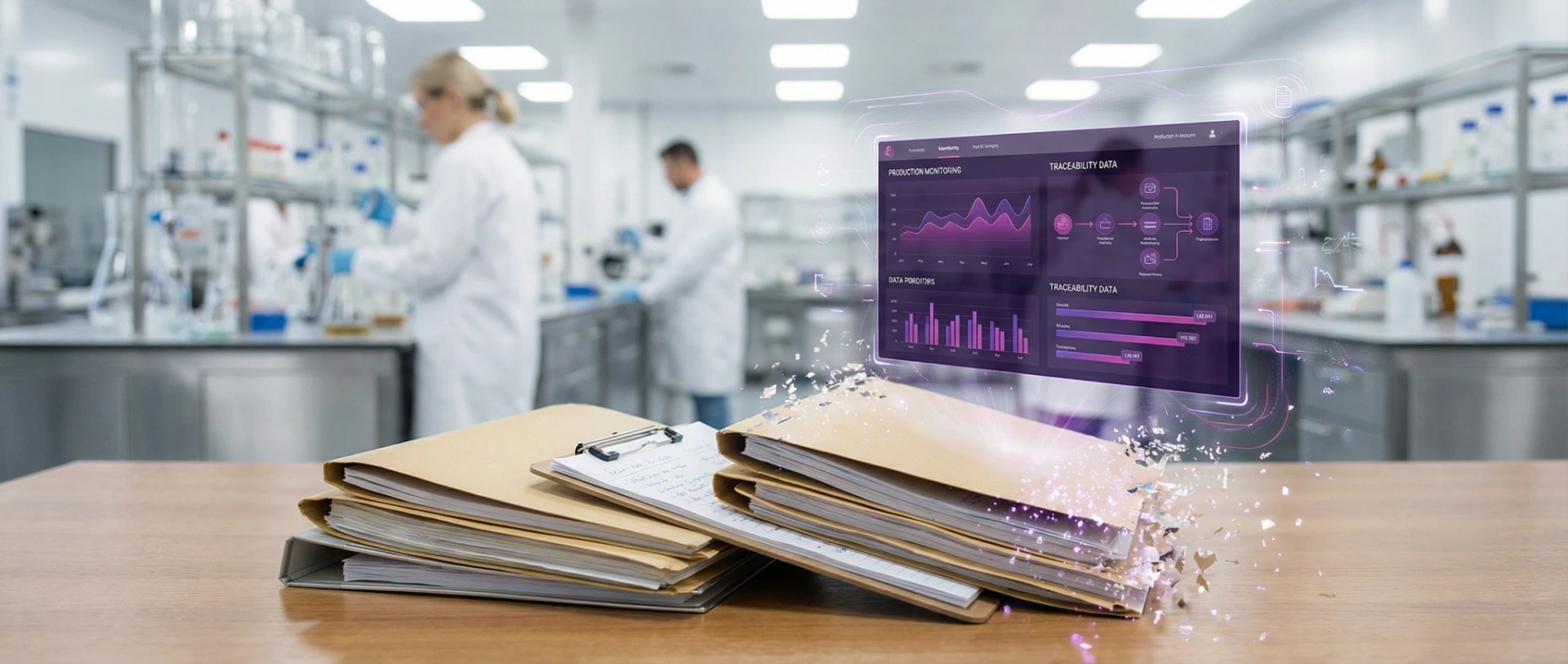
From Spreadsheets to Systems: The Practical Path
You do not need to rip out your existing processes and install a €100,000 ERP system. The progression from paper to production intelligence follows a practical, incremental path.
Level 1: Paper and ad hoc spreadsheets
This is where many smaller manufacturers still operate. Batch records on paper forms, quality results in a folder, dispatch notes in another system. It works until an auditor asks for cross-referenced data or a recall test exposes the gaps.
Level 2: Structured spreadsheet templates
Standardised Excel templates with consistent batch numbering, mandatory fields, and defined formats. This is a significant step up and costs nothing. The limitation is that spreadsheets do not enforce consistency or link data across production stages automatically.
Level 3: Connected dashboards
Data from spreadsheets or existing systems pulled into a reporting tool (Power BI, Looker, or similar) that gives real time visibility of production, quality, and traceability. This effectively replaces manual paperwork with HACCP digital logging, ensuring your critical control points are automatically tracked and timestamped. This is where most of our clients start seeing the value of their data beyond compliance. Typical cost: €5,000 to €15,000 depending on data sources and complexity.
Level 4: Integrated digital system
A purpose built or configured system where batch records, quality data, and traceability are captured at source, linked automatically, and available for both compliance and analytics. We pull data from your existing factory scales, barcode scanners, and ERPs (like Emydex or SAP) so operators do not have to double enter data. Typical cost: €15,000 to €50,000+ depending on scope and integration requirements.
Level 5: Predictive production intelligence
Your structured, digital data is now used not just for compliance and reporting, but for prediction: forecasting quality outcomes, optimising yield, detecting problems early, and even supporting predictive maintenance on processing equipment. This is what we covered in detail in Predictive Quality in Food Manufacturing. The foundation is the clean, structured data you built in Levels 2 through 4.
You do not need to jump to Level 5 on day one. Most manufacturers we work with start at Level 2 or 3 and build from there. The important thing is that every step adds value, both for compliance and for production improvement.
What This Looks Like in Practice
Here is an anonymised scenario drawn from a real engagement with an Irish food manufacturer.
The Starting Point
A food manufacturer supplying Irish and UK retailers was preparing for a BRCGS audit. Their batch records were a combination of handwritten production sheets, Excel files updated daily by the QA team, and a separate system for dispatch records. A mock recall test had taken over six hours to complete. Their customer (a major Irish retailer) had specifically flagged traceability as a concern during their last supplier review.
Data Audit and Structuring
We started by mapping every data source: production sheets, quality test results, raw material records, dispatch logs, supplier certificates. The data existed, but in seven different formats across four different locations. Our first job was to reconcile these into a single, consistent structure linked by batch number.
This is always the hardest part. Approximately 60% of the project effort went into cleaning and structuring the data, which is consistent with what we describe in our project process guide.
Digital Traceability Dashboard
Using the structured data, we built a dashboard that gave the QA team instant visibility of any batch: raw material inputs, production parameters, quality test results, and dispatch destinations. What previously required hours of cross-referencing folders and spreadsheets could now be retrieved in seconds.
The mock recall test that had taken six hours was repeated using the new system. It took twelve minutes.
The Unexpected Discovery
With the data now structured and queryable, we ran exploratory analysis across 18 months of production history. The manufacturer had been experiencing intermittent quality issues with one product line but had not been able to identify the cause. The structured data revealed a clear correlation between a specific raw material supplier's batch characteristics and the quality problems. The pattern had been invisible when the data was scattered across paper and spreadsheets.
The manufacturer adjusted their supplier specifications and implemented targeted incoming inspection. The quality issue reduced by over 70% in the following quarter.
What started as a compliance fix became a production improvement project.

Honest Note
Not every traceability project leads to a dramatic discovery like this. Sometimes the main outcome is simply faster audit preparation, better recall readiness, and less time spent on paperwork. That is still a valuable return. But in our experience, once the data is clean and structured, the opportunities for production insight emerge more often than not. We are transparent about this with every client before an engagement begins.
What It Costs and How to Fund It
Traceability and quality improvement projects are exactly what Irish government grants are designed to fund. These engagements are typically delivered through our Data Analytics & Predictive Modelling service, which covers everything from data preparation to working prototype tools.
| What You Need | Typical Cost | Grant Funding Available |
|---|---|---|
| Data audit and roadmap | €3,000 to €6,000 | Enterprise Ireland Digital Discovery: 80% funded (up to €5,000). Your cost: ~€1,000 |
| Structured traceability system | €10,000 to €25,000 | Enterprise Ireland Digital Process Innovation: up to 50% funded |
| Full digital traceability + analytics | €25,000 to €50,000+ | Enterprise Ireland Innovation Partnership: up to 50% funded. LEO grants also available for businesses under 50 employees |
The Enterprise Ireland Digital Discovery grant is the ideal starting point. For an out of pocket cost of approximately €1,000, you get a professional assessment of your current traceability data, a gap analysis, and a roadmap for what analytics could deliver. This also gives you the documentation you need to apply for larger implementation grants. See our complete guide to AI grants in Ireland for all available options.
Getting Started
If you are a food manufacturer in Ireland and you recognise the traceability challenges described in this article, here is the practical path forward.
Map your current data
List every place you record batch, quality, production, and traceability information. Spreadsheets, paper forms, ERP exports, quality logs, dispatch systems. Most manufacturers are surprised by how many sources they have.
Identify the gaps
Where does the chain break? Can you trace a finished product back to every raw material batch and forward to every customer? How long does that take? If the answer is more than an hour, there is room to improve.
Get a professional assessment
Enterprise Ireland's Digital Discovery grant covers 80% of the cost. We will assess your data, identify the opportunities, and give you a roadmap, whether you work with us or someone else.
Start small
You do not need a full digital transformation on day one. Structured spreadsheet templates or a basic dashboard can deliver immediate value for audit preparation and QA reporting in food manufacturing, giving you faster recall response and cleaner documentation without a major investment.
Build toward intelligence
Once your data is structured and digital, the path to quality prediction and yield optimisation opens up naturally. See our guides on moving from Excel to predictive analytics and predictive quality in food manufacturing for what becomes possible.
For a detailed walkthrough of what each project phase involves, see our guide to what a data analytics project actually looks like.
Frequently Asked Questions
What does food traceability actually require under Irish and EU law?
EU Regulation 178/2002 requires "one up, one down" traceability: knowing who supplied you and who you supplied. The FSAI clarifies that batch level tracing is not legally mandatory, but operating without it "may carry a high financial risk" because in the event of a recall, you would have to recall all product with that name rather than isolating the affected batches. In practice, batch level tracing is expected by all major retailers and certification bodies.
How long should a mock recall test take?
Best practice is under 30 minutes. BRCGS auditors typically allow four hours during an audit. If your mock recall test takes more than two hours, your system has gaps that need attention. The most common cause of slow recall tests is data scattered across multiple formats and locations.
Do we need to replace our existing systems to improve traceability?
No. Most projects start by structuring and connecting the data you already have. Spreadsheets, ERP exports, and paper records can all be reconciled into a consistent format without replacing any existing system. The goal is to make your current data work harder, not to install expensive new software.
How does traceability connect to quality prediction and analytics?
The batch records you maintain for traceability (production parameters, raw material specs, quality test results) are the same data used for predictive quality modelling. Once your traceability data is structured and digital, you can analyse it for patterns that predict quality outcomes, optimise yield, and detect problems early. Compliance and production intelligence are built on the same foundation.
Are there grants available for traceability improvement projects in Ireland?
Yes. Enterprise Ireland's Digital Discovery grant covers 80% of costs (up to €5,000) for an initial assessment and roadmap. Larger implementation projects qualify for the Digital Process Innovation grant at up to 50% funding. LEO grants are available for businesses with fewer than 50 employees. See our complete guide to AI grants in Ireland.
Is Your Traceability Data Working Hard Enough?
If you are an Irish food manufacturer spending too long preparing for audits, worrying about recall readiness, or sitting on years of production data you have never been able to analyse, let's talk. Book a 20 minute call and we will assess your traceability situation, explain what a project would look like, and check your eligibility for the 80% Digital Discovery Grant.
Book a 20 minute discovery callAbout Barry Gough
CTO, Deep Purple AI Consulting
Barry Gough is the CTO of Deep Purple AI Consulting. With an MSc in Computer Science from University College Dublin, where machine learning was a core focus of his studies, and over 20 years building production software systems, Barry brings formal ML training and deep hands-on engineering experience to every AI and data analytics engagement.
Barry completed his masters at UCD in 2011, studying ML algorithms, statistical modelling and data-driven systems just as big data techniques were maturing and deep learning was about to transform the industry. Barry joined Purpledecks in 2016 and has led the technical delivery of enterprise projects incorporating machine learning, computer vision, data classification, predictive features and recommendation engines for commercial clients across Ireland and the UK.
In 2023, Barry architected and built Reactable AI from the ground up as an internal Deep Purple product, a system that generated and optimised marketing campaigns across channels against measured results. Reactable AI ran in production as an autonomous agent system, requiring him to design systems where AI made real decisions with real consequences.
At Deep Purple, Barry leads all technical delivery: AI system architecture, machine learning model development, data pipeline engineering, and manages a team of experienced ML engineers and applied statisticians. His combination of formal ML education, years of incorporating AI into commercial projects and hands-on experience architecting autonomous AI systems means clients work with a technical lead who can make genuine engineering decisions about AI.
Related Resources
What Does a Data Analytics Project Actually Look Like?
A step-by-step walkthrough of the full project process, from first conversation to delivered model.
From Excel to Predictive Analytics
Starting from spreadsheets? Here's the practical journey to prediction.
Predictive Quality in Food Manufacturing
How production data predicts quality, improves yield, and reduces waste.
Enterprise Ireland Grants Guide 2026: Up to €400,000
Access up to €400,000 in funding for AI and digital transformation.
Book a Free Consultation
Discuss your traceability, your data, and your funding options.
Your Compliance Data Is Already a Business Asset
You just need to structure it properly. Book a free call to discuss how your traceability data could drive quality prediction and production intelligence.
Book Free ConsultationDeep Purple AI Consulting (deeppurple.ai) is an AI consultancy and custom software development company based in Longford, Ireland, serving clients across Ireland, the UK, the EU, and the US. We help established businesses identify where AI can make a real difference, then build the systems to make it happen. Senior-led delivery. Grant-funded where possible. No hype.