Why Irish Construction Companies Wait 75 Days to Get Paid

Founder & CEO, Deep Purple AI Consulting
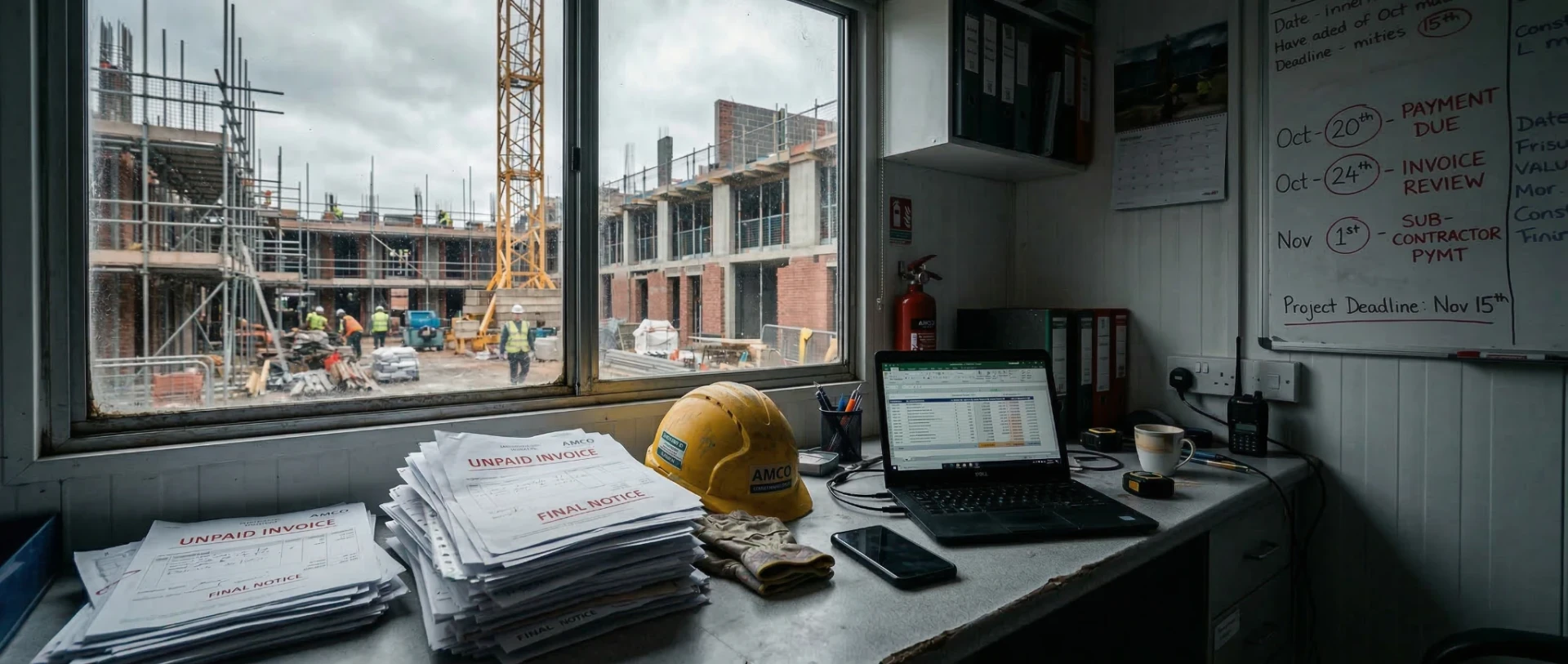
Seventy-five days. That is the average time an Irish construction company waits to be paid, according to ISME's most recent data on the sector. For specialist subcontractors, it is often longer.
Late payment is not an inconvenience. It is an existential threat. It squeezes cash flow, delays wages, stalls material purchases, and kills businesses that are profitable on paper but broke in practice.
Most people blame the client. Or the main contractor. Or the process. But many construction payment disputes in Ireland start long before the invoice is issued. The delay often begins somewhere else entirely.
We have already delivered an Irish construction deployment that addresses exactly this problem.
This article is about where the delay really starts and what changes when the evidence improves.
Where the Delay Actually Starts
It starts on site. With the measurement.
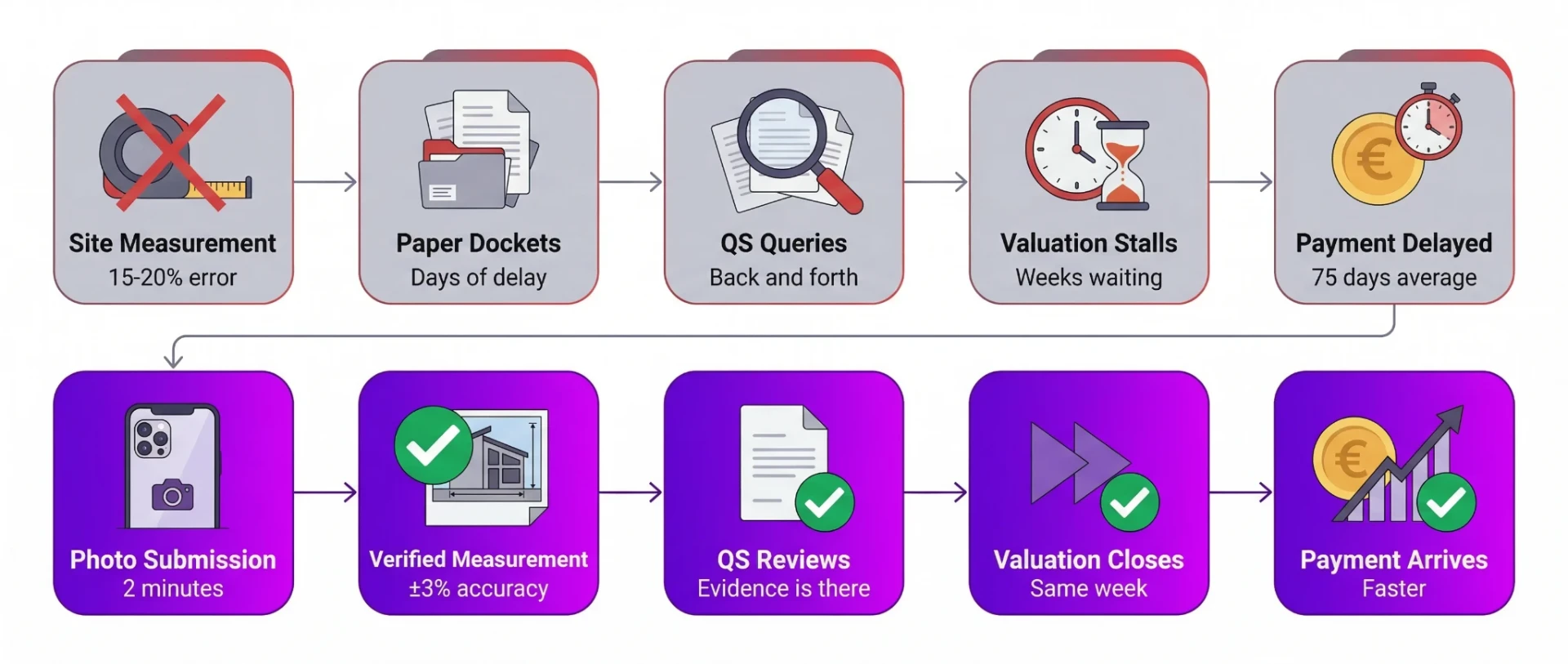
An operative measures completed work with a tape. Writes it on a docket. The docket sits in a van, a pocket, or a site office until it reaches the back office.
Someone enters the figures. Someone else checks them. Discrepancies get flagged. Queries go back to site.
By the time the numbers are clean enough to put in front of a quantity surveyor, a week has passed. Sometimes more.
The QS reviews the submission. The quantities do not match their own records. They query. The contractor cannot produce supporting evidence beyond a handwritten docket.
More back and forth. The valuation stalls. The invoice waits.
That is how 75 days happens. Not because someone is deliberately slow. Because the evidence behind the payment application is weak, and weak evidence creates friction at every step.
Under the Construction Contracts Act 2013, either party can refer a payment dispute to adjudication. Adjudication referrals in Ireland and the UK are at record levels. The quality of your documentation is often what determines the outcome.
What Quantity Surveyors Actually Need (And What They Usually Get)
A QS is not trying to make your life difficult. They have a job to do. They need to verify that the quantities you are claiming match the work that was done.
To do that properly, they need accurate quantities with supporting evidence. They need clear records of what was done, where it was done, and when. They need to be able to check your numbers against their own measurements and resolve differences quickly.
What they usually get is a different story.
Handwritten dockets, reconciled days after the work was done. Tape measure readings on irregular surfaces with 15–20% variance. No photographs. No GPS data.
Site diary evidence, on its own, rarely settles a quantity dispute. There is no way to independently verify what was there on the day the work was done.
The gap between what the QS needs and what the contractor provides is where disputes live. Not because anyone is dishonest. Because the evidence is not good enough to close the gap quickly. When both sides are working from unverifiable numbers, the relationship becomes adversarial by default.
When the QS queries a quantity, the contractor has to go back to the operative, check the dockets, sometimes remeasure. That takes time.
Every query adds days to the valuation cycle. Every delay pushes the invoice further out. Every late invoice tightens cash flow.
This is not a technology problem at first glance. It looks like an admin problem, or a process problem. But the root cause is that the measurement data coming off site is not accurate enough or well-evidenced enough to survive scrutiny.
What Changes When Every Submission Has a Photograph, a GPS Tag, and a Calculated Area
Imagine every operative submission included four things: a photograph of the completed work, a GPS location, a timestamp, and an area calculated to ±3% accuracy.
That changes the conversation with the QS entirely.
The quantities are not estimates. They are calculated from calibrated photographs. The QS can see the photograph. They can see the GPS location. They can see when the work was done. They can see the area the system calculated.
Queries drop. Not because the QS stops checking. Because there is less to query. The evidence is there.
Valuations move faster. The contractor submits with photographs and calculated areas. The QS reviews against their own records. Differences are smaller because the measurement is more accurate.
The valuation closes sooner. The invoice goes out sooner. The payment arrives sooner. That is how you strengthen your payment application.
That is how you compress the 75 days. Not by chasing harder. By submitting better evidence.
There is another angle here that most people miss. On many contracts, the final 2.5% to 5% is held as retention until the project is complete. That retention is often where the profit lives.
Verified, photo-evidenced records make it much harder for a client to sit on retention citing "incomplete documentation." In final account disputes, the quality of your records determines whether you recover what you are owed.
For a fuller picture of how this computer vision approach works in practice, see the case study below.
When This Is Worth Doing (And When It Is Not)
An Honest Assessment
This is not the right approach for every contractor.
If your contracts are lump-sum with no measurement component, verified field measurement adds less value. Your payment disputes are more likely to be about scope or variations than about quantities.
If your disputes are primarily about what was agreed rather than what was measured, better measurement data does not solve the problem. You need better contract administration, not better site evidence.
If your team cannot or will not adopt a phone-based submission workflow, this will fail. The system depends on operatives taking photographs consistently. If that does not happen, the data does not flow.
Where it does add value is on measured-works contracts, remeasurement contracts, and any project where payment is tied to verified quantities. If your QS regularly queries your submissions, this is worth looking at. If your valuations take weeks to close, or if you have lost money in final account disputes because you could not produce adequate evidence, it is worth looking at seriously. Better construction billing accuracy starts with better site evidence.
What It Costs and Who Pays Half
Our Phase 1 proof of concept cost €45,000 total. Enterprise Ireland covered 50% through their innovation funding programmes. The client's investment was €22,500.
Enterprise Ireland offers several programmes that fit projects like this, including the Exploring Innovation grant and the Digital Process Innovation grant. For smaller firms, LEO Digital for Business is another route.
For a detailed guide to what funding is available, see our complete guide to AI grants in Ireland.
This Is Already Running on Irish Construction Sites
This is not theory. We built and deployed this for an Irish construction contractor with 30–40 field operatives across multiple concurrent sites.
Paper dockets were replaced with instant, verified photo submissions. Measurement accuracy went from 15–20% variance to ±3%. The project dashboard updates in real time. Every submission is GPS-stamped, timestamped, and photo-evidenced.
The full story, including what failed during development and how we fixed it, is in the case study of our Irish construction deployment.
For the operational detail on how verified measurement compares to standard digital docket tools, see our article on why digital dockets still have a measurement problem.
If your valuations are stalling because of weak site evidence, we are happy to look at whether verified measurement fits your operation. No pitch. Just an honest conversation about whether it is worth doing.
Valuations stalling because of weak site evidence? Let's look at whether verified measurement could speed up your payment cycle.
Book a 20-Minute Intro CallWhat Six Months of Verified Data Does to Your Quoting
This is the longer-term advantage that most people do not think about at first.
After six to twelve months of verified submissions, the company has a dataset that no competitor can match. Verified output per operative, per material type, per weather condition, per season. That is not a spreadsheet estimate. That is evidence.
When the next tender comes around, the company quotes from data, not from experience and gut feel. More accurate quotes mean winning more work at the right margin. The data grows more valuable with every month the system runs.
Deep Purple builds computer vision systems that produce GPS-stamped, photo-evidenced, area-calculated site records. Irish construction companies use these to speed up valuations, reduce QS disputes, and strengthen payment applications under the Construction Contracts Act.
Frequently Asked Questions
Start with a 20-Minute Conversation
No pitch, no pressure. Just an honest look at whether verified measurement could help your construction business get paid faster.
Book a 20-Minute Intro CallOr start with a €1,000 AI Assessment →Related Reading
Not sure if your business is ready?
Take our free 3-minute feasibility assessment. It covers construction, manufacturing, and infrastructure inspection. You'll get an instant readiness score with specific recommendations.
Take the AssessmentAbout Brian Egan
Founder & CEO, Deep Purple AI Consulting
Brian Egan is the Founder and CEO of Deep Purple AI Consulting. With over 26 years in software and AI, from studying neural networks at Dublin City University, to building intelligent mobile systems for Vodafone, Nokia and Hutchison 3G, to building technology companies that delivered machine learning, computer vision and predictive AI solutions to real businesses, Brian has been building with AI technologies at every stage of their evolution.
His interest in artificial intelligence began at DCU, where he studied neural networks and pattern recognition as part of his BSc in Computer Applications. As a Marie Curie Research Fellow in Germany, he worked on EU Framework projects developing intelligent systems for integrating emerging mobile technologies with enterprise software. At Cibenix (2003 to 2011), he spent eight years designing on-device software for Vodafone, Nokia, Hutchison 3G, Sony Ericsson and other global operators, work that increasingly involved content personalisation, user behaviour analysis and adaptive delivery logic.
In 2012, Brian founded Purpledecks, a software consultancy that incorporated machine learning, computer vision, data classification, predictive features and recommendation engines into client projects years before the current generative AI wave. From Purpledecks came Hype4 (UX research including AI-powered biometric identification for government programmes) and Reactable AI, the Deep Purple team's own agent product, funded by Enterprise Ireland's Pre-Seed Start Fund, with a new version launching September 2026.
A former Marie Curie Research Fellow, Brian leads Deep Purple's work with established businesses across Ireland, the UK, the EU, and the US, helping them identify where AI delivers genuine commercial value and guiding them from first assessment through to working system.
Deep Purple AI Consulting (deeppurple.ai) is an AI consultancy and custom software development company based in Longford, Ireland, serving clients across Ireland, the UK, the EU, and the US. We help established businesses identify where AI can make a real difference, then build the systems to make it happen. Senior-led delivery. Grant-funded where possible. No hype.