Computer Vision and Machine Vision Systems for Irish Businesses
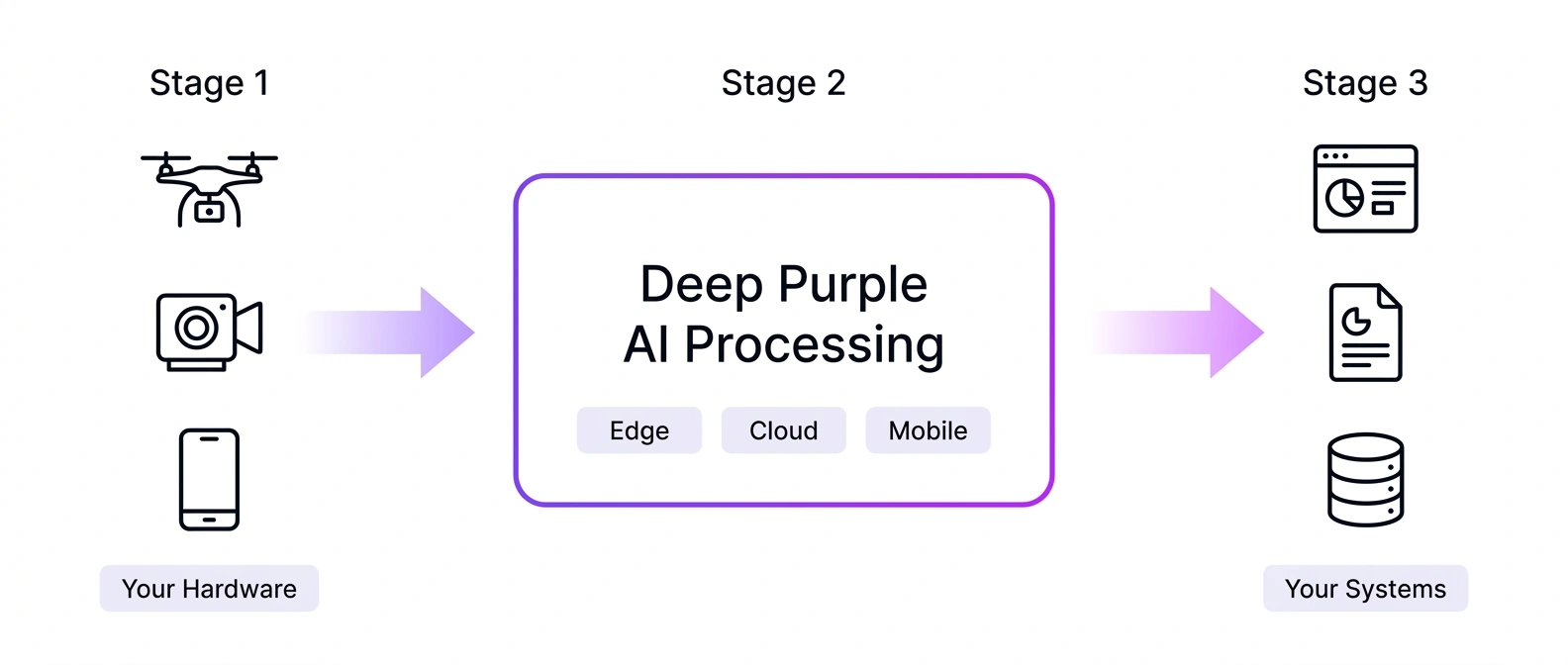
We build the software that turns cameras into intelligent measurement, inspection, and quality control tools. Phones on building sites. Industrial cameras on production lines. Drones over wind farms. Thermal sensors on solar arrays. The intelligence comes from the software.
Deep Purple builds custom computer vision and machine vision systems for established Irish businesses. We design and develop the software that processes images and video to measure, inspect, classify, and detect. Whether the camera is a phone on a building site or an industrial rig on a production line, the intelligence comes from the software behind it. That is what we build.
We are not a hardware company. We do not sell cameras, sensors, or lighting rigs. We build the software that makes them intelligent. Whether you are a manufacturer with Keyence cameras on your production line, a drone company processing thousands of inspection images, a utility company documenting infrastructure, or a construction firm measuring site progress, Deep Purple builds the software that turns your visual data into decisions.
Quick Summary
What Deep Purple Builds:
- Computer vision and machine vision software for construction, drone inspection, telecoms and infrastructure, manufacturing, and field operations
- Custom systems trained on your specific data and environment
- Works with your existing cameras (Keyence, Cognex, Basler, or others) or we specify what you need
Typical engagement:
- •Feasibility assessment: 2–4 weeks, €3,000–€8,000
- •Proof of concept: 4–8 weeks, €8,000–€30,000
- •Full production system: 3–6 months, €30,000–€120,000
- •Government grant funding available for eligible businesses
What makes Deep Purple different:
- We build the software and integrations, not the hardware
- Expert feedback loop that makes the system smarter over time
- Systems work offline, on-edge, or in the cloud
- Deep Purple has deployed production CV on Irish construction sites and predictive quality models in Irish food manufacturing
Who We Work With
Our clients range from owner-managed businesses with 15 employees to departments within organisations of 13,000+. At larger organisations, we typically work with a specific function or department rather than on enterprise-wide programmes.
We regularly engage with Heads of R&D, Operations Directors, Engineering Directors, and Heads of Quality who need computer vision systems that deliver measurable outcomes in their own area of the business.
Automate Quality Checks and Reduce Manual Measurement
Computer vision is software that processes images or video and extracts useful information from them. In practical terms, it means a camera connected to a system that can do things a human eye and brain currently do, but faster, more consistently, and at scale.
The applications span industries:
- Detecting defects on a production line
- Measuring material quantities from site photographs
- Processing thousands of drone inspection images automatically
- Identifying and classifying equipment on utility poles
- Verifying barcodes, labels, and packaging
- Tracking site progress across multiple locations
- Counting and measuring components from images
The technology is not new. What has changed is that it is now practical and affordable for businesses outside the Fortune 500. The hardware costs have dropped. The software tools have matured. And with the right expertise, a custom system can be built and deployed in weeks, not years.
A typical machine vision pilot costs €15,000 to €25,000 and runs for 4 to 6 weeks. For eligible Irish businesses, grant funding can cover up to 50% of project costs. The goal is zero-defect manufacturing: catching every issue before it reaches the customer, consistently and automatically.
Common Inspection Tasks Deep Purple Automates
| Inspection Type | What the System Does |
|---|---|
| Surface defect detection | Identifies scratches, dents, cracks, or contamination on product surfaces |
| Seal and cap verification | Confirms closures are properly seated, aligned, and undamaged |
| Label verification | Checks label placement, text accuracy, barcode readability, and regulatory compliance |
| Fill level inspection | Measures fill levels in bottles, containers, or packaging |
| Barcode and OCR reading | Reads and validates barcodes, QR codes, lot numbers, and date codes |
| Component counting | Counts items in trays, bins, or assemblies with high accuracy |
| Packaging integrity | Detects damaged, misaligned, or missing packaging elements |
| Colour and grade classification | Sorts products by visual grade, colour, or ripeness |
| Aerial defect detection | Flags cracks, erosion, or damage in drone inspection imagery |
| Field measurement | Calculates area, volume, or dimensions from calibrated photographs |
| Equipment identification | Classifies and catalogues equipment from pole, tower, or site photographs |
Computer Vision for Drone and Aerial Inspection
Irish drone operators capture thousands of high-resolution images every week. Wind turbine blades, solar panels, roofs, bridges, telecoms towers, and industrial assets. The images contain valuable information about defects, damage, and deterioration. The problem is that someone has to look at every one of them.
Deep Purple builds the software that processes drone inspection imagery automatically. Instead of a human reviewing 4,000 photos from a wind farm, the system classifies each image, flags anomalies, identifies defect types, and produces structured reports. Your team reviews the flagged items. Not the entire dataset.
What Deep Purple builds for drone and aerial inspection:
- Automated defect detection for wind turbine blades from visual and thermal imagery (leading edge erosion, cracks, lightning damage, surface contamination)
- Solar panel inspection (hotspot detection, micro-crack identification, soiling classification from thermal and visual imagery)
- Roof and building inspection (crack detection, slate damage, water ingress indicators, vegetation growth)
- Bridge and infrastructure assessment (concrete spalling, joint deterioration, corrosion classification)
- Telecoms tower inspection (equipment identification, antenna alignment, structural condition)
How it works with your existing workflow:
Deep Purple does not fly drones. We build the intelligence that processes what your drones capture. You keep flying. Deep Purple makes the images useful.
For drone operators, Deep Purple builds processing pipelines that reduce manual review time and produce structured reports your clients can act on. For asset owners and infrastructure managers, Deep Purple builds inspection dashboards that give you centralised visibility of defect status, maintenance priorities, and condition trends across your entire asset portfolio. Whether you fly the drones or hire someone who does, Deep Purple builds the intelligence layer.
The system integrates with your existing image capture workflow. Your pilots upload imagery. The system processes it automatically. Reports are generated. Your inspectors review flagged items instead of every image.
Every inspection generates a structured report: defects classified by type and severity, images annotated with findings, GPS coordinates linked to each defect, and a summary your team can hand to a client, insurer, or board. Deep Purple builds the reporting to match the format your business needs.
Why this matters now:
Ireland is targeting 9 GW of onshore wind capacity by 2030, with offshore targets of 5 to 7 GW depending on the planning pathway. Multiple GW-scale offshore wind farms are in planning or early construction. Every turbine has three blades, each needing periodic inspection. The volume of inspection imagery is growing faster than the number of people who can review it. Computer vision is the only way to scale inspection without scaling headcount.
Currently, Irish drone companies who need AI capability go to research centres for prototype models. Deep Purple is a commercial provider that builds production systems, not prototypes.
Deep Purple designs systems that drone operators can reuse across multiple inspection jobs. The model is trained once on your defect types and deployed as a platform your team uses on every job. You are not buying a one-off project. You are building a competitive advantage.
As Irish drone regulations evolve to support BVLOS (Beyond Visual Line of Sight) operations, automated image processing becomes essential. When a drone flies a route without a pilot watching the live feed, the only way to assess what it captured is through automated analysis. Deep Purple builds systems ready for this shift.
For a detailed look at how custom software automates the drone image review bottleneck, see our article on drone inspection software for Irish infrastructure.
Deep Purple is an Irish AI consultancy based in Longford that builds custom computer vision software for drone inspection companies and infrastructure asset owners across Ireland and the UK.
Computer Vision for Energy, Telecoms, and Infrastructure
Ireland's electricity grid is entering the largest period of investment since rural electrification. The CRU's Price Review 6 approved up to €18.9 billion in grid investment for 2026 to 2030, backed by €3.5 billion in government equity. The programme includes over 500 capital projects, tens of thousands of pole replacements, 181km of new overhead line, and 876km of increased capacity on existing infrastructure. The grid must be upgraded to support 9 GW of onshore wind, over 5 GW of solar, 5 GW of offshore wind, one million electric vehicles, and 680,000 heat pumps.
Every pole, substation, transformer, and overhead line will need to be inspected, documented, and monitored. ESB Networks currently uses helicopter patrols for powerline inspection. That approach is expensive, weather-dependent, and disruptive. Internationally, utilities that have moved to drone-based inspection with computer vision report collecting hundreds of thousands of images per inspection cycle. The bottleneck is no longer data capture. It is the manual review of those images.
The companies doing this inspection work are the tier 1 and tier 2 contractors who win ESB Networks and EirGrid maintenance frameworks. Deep Purple gives these contractors a competitive edge: automated image processing that reduces review time, standardises evidence packs, and produces structured reports in the formats their clients require.
At the same time, the National Broadband Plan has completed surveying tens of thousands of telecoms poles. The maintenance and condition monitoring phase is now starting and runs for decades.
Deep Purple builds the software that processes this infrastructure imagery automatically:
- Measuring pole heights from calibrated photographs
- Identifying and classifying equipment on poles and substations (transformers, cables, insulators, switchgear, fibre attachments)
- Assessing condition from visual indicators (rust, lean, corrosion, damage, vegetation encroachment)
- Overhead line inspection and clearance verification
- Cable routing verification and capacity assessment
- Road surface condition assessment from vehicle-mounted cameras
- Public lighting and signage condition monitoring
- Vegetation encroachment detection and clearance verification
- Substation equipment condition monitoring (thermal and visual)
- Distribution and transmission network asset documentation
- Water and wastewater infrastructure visual inspection (treatment plant condition monitoring, reservoir site documentation)
Deep Purple does not provide drone services or inspection hardware. We do not compete with your existing drone operators or field inspection teams. We build the software intelligence layer that processes the imagery they capture.
This is classical computer vision work: measurement, classification, and condition assessment from images. It is exactly what Deep Purple builds.
For energy providers, utility companies, semi-state bodies (ESB Networks, EirGrid, Uisce Eireann, Gas Networks Ireland), and their maintenance contractors, Deep Purple builds the software that turns field photographs into structured, auditable data.
Deep Purple's leadership team has direct experience building software for telecoms construction and infrastructure mapping. This is not a new capability for us. It is an extension of work we have been doing for years.
Systems integrate with existing asset management and GIS platforms. Defect detections and asset classifications are tied to exact GPS coordinates, exportable to QGIS, ArcGIS, or your existing spatial data infrastructure.
Deep Purple builds computer vision software that processes energy infrastructure, utility pole, telecoms, and fibre network imagery for Irish energy companies, utility providers, semi-state bodies, and their contractors.
Computer Vision for Construction and Field Operations
Deep Purple has deployed a computer vision field measurement platform on Irish construction sites. This is not a planned capability. It is a working system in production use.
The construction industry captures enormous amounts of visual data. Site photographs, drone overflights, progress images, snagging documentation. Most of it is stored and never analysed. Deep Purple builds systems that extract value from this imagery.
Field Measurement from Photos
Measure material area and volume from photographs using calibration markers and computer vision.
Multi-Site Progress Tracking
Track site progress across multiple locations from a central real-time dashboard.
Work Verification
Verify completed work against specifications with photo-evidenced, timestamped submissions.
Automated Documentation
Automate field documentation and reporting. Data flows directly into billing, quality, and progress systems.
Dispute Reduction
Reduce disputes with objective, timestamped visual evidence attached to every submission.
Our deployed system replaced paper dockets and days of back-office reconciliation with instant, photo-evidenced submissions — improving measurement accuracy from 15–20% variance (tape measures on irregular surfaces) to ±3%, consistently achieved. Read the construction field measurement case study →
Computer vision also supports PPE detection and safety compliance monitoring on construction sites, automatically flagging when workers enter exclusion zones without required protective equipment.
If your business involves people going to sites, taking photographs, and someone back in the office making sense of them, there is almost certainly a way to automate part of that process.
Deep Purple has deployed a production computer vision field measurement system on Irish construction sites, achieving ±3% measurement accuracy with real-time visibility across all sites.
Computer Vision for Manufacturing and Quality Control
For manufacturing businesses, Deep Purple builds custom inspection and quality control systems. The Common Inspection Tasks table above covers the most frequent applications: surface defect detection, seal verification, label checks, fill level monitoring, barcode reading, and component counting.
Deep Purple also works with businesses that already have camera hardware installed. If you have Keyence, Cognex, Basler, or other vision equipment on your production line, Deep Purple builds custom software that makes your existing investment smarter. You do not need to replace your cameras. You need better intelligence behind them.
For regulated industries (pharma, medical devices, food production), Deep Purple builds systems with immutable audit trails, access controls, and version-controlled model changes. Full details are in the Validation section below.
Deep Purple has delivered a predictive quality model for an Irish food manufacturer, demonstrating ML capability in a manufacturing environment. The case study is published at /case-studies/predictive-quality-food-manufacturing.
For a detailed look at how custom machine vision software works with existing camera hardware, including what usually breaks first and what a safe pilot looks like, read our guide: Machine Vision Software for Irish Manufacturers.
Deep Purple builds custom machine vision inspection software for Irish manufacturers, working with existing Keyence, Cognex, and Basler camera systems and building to GAMP5 and 21 CFR Part 11 validation standards where required.
Other Applications
Computer vision applies wherever images contain information that humans currently process manually. Deep Purple also has capability in logistics and warehousing (inventory counting, damage detection), agriculture and food production (quality grading, foreign body detection), and insurance (damage assessment from field photographs).
Deep Purple's field measurement technology, the same system deployed on construction sites, can measure stockpile volumes from drone or ground-level photography. For quarry operators managing multiple sites, this replaces manual survey with automated, timestamped measurement that feeds into centralised reporting.
If your business captures images as part of its operations, start with a feasibility conversation.
How Deep Purple Builds Your System
Every CV project follows our standard delivery process: Discovery, Strategy, Build, Support. But computer vision has specific technical steps that matter.
1. Feasibility Assessment — Check whether computer vision can solve your specific problem. Assess environment, hardware, accuracy, and failure modes.
2. Data Collection & Calibration — Collect training data from your actual environment and build calibration into the system from day one.
3. Model Development — Build custom models trained on your specific data — classical CV or machine learning depending on the problem.
4. Integration & Deployment — Build the full system: application, interface, data pipeline, and integration with your existing business systems.
5. Expert Feedback Loop — Your operators validate outputs and feed corrections back into the model, making it more accurate over time.
Feasibility Deliverables
- Clear answer on whether CV can solve the problem
- Expected accuracy range based on your environment
- Hardware recommendations (use existing or specify new)
- Lighting assessment and recommendations
- Cost estimate for proof of concept and full build
- Grant funding options
Deployment Deliverables
- Working application (web, mobile, or both)
- User interface for your operators
- Integration with existing business systems
- Deployment on cloud, edge, or on-premise as required
- Training for your team
The most important part of any CV system is what happens after deployment. Deep Purple builds in a human review step where your experienced operators validate the system's output. Their corrections feed back into the model, making it more accurate over time.
This is not a weakness. It is the mechanism by which the system gets smarter. Every correction your team makes improves the model. After weeks and months of real use, the system becomes more accurate than any pre-built solution could ever be, because it has learned from your specific environment.
Your experts stay in control. The system helps them focus their limited time on the decisions that actually matter.
What Deep Purple Has Built in Ireland
Computer Vision for Construction Field Operations
Deep Purple built and deployed a computer vision platform for an Irish construction company with 30–40 field operatives across multiple sites in Ireland, the UK, and Europe. The system replaced paper dockets and days of back-office reconciliation with instant, photo-evidenced submissions. Operatives photograph their work, draw an outline, and submit. Two minutes. The data is in the system. Progress reports, billing, and quality review update automatically across every site.
2-Minute Submissions
Field operatives photograph, outline, and submit. Paper dockets and days of reconciliation eliminated.
±3% Accuracy
Measurement accuracy consistently achieved across all sites — Ireland, UK, and Europe.
Real-Time Dashboard
Progress, billing, and quality data update automatically. Visibility across every site from one screen.
Predictive Quality in Food Manufacturing
Deep Purple has also delivered a predictive quality model for an Irish food manufacturer. The system analyses production data to predict product quality outcomes before they are measured, allowing the production team to intervene earlier and reduce waste.
This project demonstrates the same core capability applied to manufacturing: training models on real operational data to make better decisions faster. The detailed case study is published at /case-studies/predictive-quality-food-manufacturing.
How Deep Purple Is Different From a Hardware Integrator
Traditional machine vision integrators sell cameras, lighting, and inspection stations. They build systems that check one thing at one point on a production line. That is valuable work.
Deep Purple does something different. Deep Purple builds the software platform around the vision system. This includes:
- Multi-point inspection across an entire line, not just one station
- Workflow integration so inspection results flow into your ERP, quality system, or reporting tools
- A human review interface where your team validates results and feeds corrections back into the model
- Multi-site dashboards that give you visibility across all locations from one screen
- Continuous improvement through a feedback loop that makes the system more accurate over time
- Processing large volumes of drone or field imagery that inspection stations are not designed for
If you already work with a hardware integrator, Deep Purple complements them. We are not competing for the same work. They provide the eyes. Deep Purple provides the intelligence.
For Hardware Companies: Partnering With Deep Purple
If you sell cameras, sensors, or inspection hardware and your clients are asking for smarter software, Deep Purple may be the partner you need.
We build the custom software layer that makes hardware intelligent. We do not sell hardware. We do not compete with you. We complement what you already provide.
What a partnership looks like:
- You sell and install the hardware. Deep Purple builds the custom software.
- We work together on the client engagement. One team from the client's perspective.
- Deep Purple handles AI model development, application build, integration, and deployment.
- You maintain the hardware relationship. We maintain the software.
Ownership is clear. After full payment, the client owns the software and all outputs. Deep Purple does not sell hardware and does not compete for your client relationship.
If you introduce Deep Purple to a client, you remain the primary relationship for hardware and service. We can co-deliver under your brand or work alongside you as a named software partner. You choose the model that works for your business.
If you are a machine vision integrator, an automation supplier, or a hardware distributor and you want to offer your clients AI-powered software without building a software team, contact Deep Purple.
Working With Your Existing Hardware
If you already have cameras, sensors, or inspection equipment installed (Keyence, Cognex, Basler, Hikvision, or others), Deep Purple can build custom software that works with your existing hardware. You do not need to replace what you have. You need smarter software behind it.
If you do not have hardware yet, Deep Purple will recommend what you need based on your specific environment and requirements. We work with hardware partners to source and install equipment as part of the project. You deal with Deep Purple. One team, one relationship, one system.
Validation, Audit Trails, and Traceability
For clients in regulated industries such as pharma, medical devices, and food production, Deep Purple builds computer vision systems that meet validation requirements.
Deep Purple systems include:
- Immutable audit trails. Every decision the system makes is recorded and cannot be altered.
- Role-based access controls. Define who can approve, override, or modify system behaviour.
- Version-controlled model changes. When the model is retrained, previous versions are preserved with full change history.
- Exportable records for regulatory audit. All inspection data, decisions, and operator reviews are available in auditable format.
Where projects require formal IQ/OQ/PQ validation, Deep Purple works with specialist validation partners to ensure full compliance with GAMP5 and 21 CFR Part 11 requirements. Deep Purple manages the project. You get one team, one relationship, one validated system.
Deep Purple is not a validation consultancy. Deep Purple is the software team that builds the system your QA team needs to validate. We understand what regulated environments require and we build to that standard from day one.
Key Technical Capabilities
| Capability | What It Means | Typical Implementation |
|---|---|---|
| Custom model training | Models trained on your specific data, not generic datasets | 200–2,000+ labelled images from your environment |
| Classical CV (OpenCV) | Measurement, counting, geometric analysis without ML overhead | ArUco markers, contour detection, calibrated measurement |
| ML defect detection | Pattern-based detection that improves with expert feedback | Convolutional neural networks trained on your defect types |
| Mobile deployment | iOS and Android apps for field use | React Native with offline sync capability |
| Offline capability | Systems that work without internet connectivity | On-device processing with background data sync |
| Edge computing | Real-time processing on local hardware | Industrial PC, Nvidia Jetson, or on-camera processing |
| Cloud processing | Multi-site data aggregation and reporting | Google Cloud, with data residency options |
| ERP and system integration | Connect CV outputs to your existing business systems | API or database integration with Sage, SAP, Dynamics, or custom systems |
| Expert feedback loop | Human review that continuously improves accuracy | Review queue, labelling interface, retraining pipeline, drift monitoring |
| Audit trail and traceability | Immutable logging for regulated environments | Every decision, review, and model change recorded and exportable |
| Multi-site dashboards | Centralised visibility across all locations | Real-time status, KPIs, and alerts per site |
| Batch image processing | Processing thousands of images from drones or field surveys | Automated classification, anomaly flagging, structured reporting |
| Geospatial (GIS) integration | Tying defect detections and asset classifications to GPS coordinates | Export to QGIS, ArcGIS, or client spatial data infrastructure |
Where This Works Well (and Where It Struggles)
Where It Works Well
- Repetitive visual inspection tasks where humans get fatigued or inconsistent
- Measurement tasks that are currently manual, slow, and error-prone
- Quality grading where subjective human judgement creates disputes
- Any visual task performed hundreds or thousands of times per day
- Multi-site operations where consistency across locations matters
- Processing large volumes of drone or aerial imagery that humans cannot review manually
- Documenting and classifying infrastructure assets from field photographs
Where Computer Vision Struggles (and How Deep Purple Handles It)
Low contrast environments. If the defect looks almost identical to the good product under current lighting, detection is harder. Deep Purple assesses this during feasibility. In many cases, better lighting or a different camera angle solves the problem. Sometimes it does not, and Deep Purple will tell you before you spend money on a build.
Highly variable products. Handmade goods or natural products with high visual variation require more training data and may not reach the accuracy you need. Deep Purple identifies this risk early and sets realistic accuracy targets during the proof of concept.
Extreme conditions. Heavy steam, constant vibration, or always-wet surfaces create challenges. These are solvable but add cost and complexity. Deep Purple factors environmental conditions into every feasibility assessment.
Problems that are not visual. If the defect cannot be seen by a human eye in a photograph, a camera will not find it either. Some quality problems need sensors, not cameras. Deep Purple will tell you if this is the case.
Every one of these risks is assessed during the feasibility stage. You will know what works and what does not before you commit to a build.
What It Costs
Computer vision projects vary significantly in cost depending on complexity, the number of inspection or measurement points, and whether hardware is included.
| Engagement | Typical Range | What You Get |
|---|---|---|
| CV Feasibility Assessment | €3,000 to €8,000 | A clear answer on whether CV can solve your problem, what accuracy to expect, and what it would cost to build |
| Proof of Concept | €8,000 to €30,000 | A working prototype tested in your actual environment, proving the technology works before you commit to a full build |
| Full CV System Build | €30,000 to €120,000 | Production-ready system: model, application, integration, deployment, training, and handover |
| Ongoing Support | €1,500 to €3,000/month | Model monitoring, retraining, system updates, and technical support |
Government grant funding is available for eligible Irish businesses. LEO and Enterprise Ireland programmes can cover 50–80% of project costs. Deep Purple helps with applications.
How Grant Funding Works for Computer Vision Projects
For eligible Irish businesses, a typical grant-funded path looks like this:
Feasibility assessment. LEO Digital for Business can cover up to 80% of a €5,000 engagement. Your cost: as little as €1,000.
Build. Enterprise Ireland Innovation or Digital Process Innovation grants can cover up to 50% of the build cost. A full CV system that costs €60,000 could cost your business €30,000 after grants.
Ongoing support. Not typically grant-funded, but the system should be generating returns that cover it within months.
Deep Purple handles the grant applications and technical documentation. We guide eligible clients through the process as part of every engagement.
Typical Return on Investment
Computer vision systems typically pay for themselves within 6 to 18 months. The payback depends on what the system replaces and the cost of getting it wrong.
For example, if manual inspection currently costs your business 20 hours per week at €25 per hour, that is €26,000 per year. A CV system that reduces manual review by 80% saves over €20,000 annually, paying back a €30,000 investment in under 18 months.
Use the calculator below to estimate your own savings.
Estimate Your Savings
This is an indicative estimate only. Deep Purple models the expected return for your specific business as part of every feasibility assessment.
The Bigger Return: Capacity, Not Just Cost
This calculator estimates direct labour savings only. For many businesses, the larger return comes from increased capacity. The same team can process more inspections, take on more contracts, and deliver more billable output without additional hires.
A drone inspection company reviewing images manually might process two or three wind farms per week. With automated defect flagging, the same team could process five to eight. Same overheads. Nearly double the revenue.
In a market where skilled inspectors, field engineers, and quality staff are increasingly hard to recruit, computer vision is not just a cost saving. It is a capacity multiplier. You scale output without scaling headcount.
Common sources of return:
- Reduced inspection labour costs (fewer hours spent on manual checking)
- Lower scrap and rework rates (catching defects earlier)
- Fewer customer complaints and returns
- Elimination of measurement disputes (construction)
- Faster throughput on production lines
- Consistent quality across shifts and sites
- Reduced manual image review time (drone and aerial inspection)
- Increased inspection capacity without additional hires
- Faster invoicing cycles (quicker turnaround from inspection to report)
Deep Purple does not make ROI promises before feasibility. But Deep Purple will model the expected return as part of every feasibility assessment so you can make an informed decision before committing to a build.
Frequently Asked Questions
See If Your Manual Process Can Be Automated
Send us a photo of your production line, a paper docket, a sample from your drone inspection dataset, or a description of what you currently measure or inspect manually. Deep Purple will tell you within 48 hours whether computer vision can automate it, what accuracy to expect, and what it would cost to prove.
For energy, infrastructure, or utility inspection: tell us what assets you inspect, how you currently review the imagery, and what reporting your clients require. We will assess whether computer vision can automate part of that workflow.
No pitch. Just a technical feasibility answer.
Book a 20-minute intro callOr email us a sample of your imagery or a description of the problem: hello@deeppurple.ai
Not ready for a call? Take our free feasibility assessment to see if your business is ready.
Want to understand the process first? See how we work →
About Brian Egan
Founder & CEO, Deep Purple AI Consulting
Brian Egan is the Founder and CEO of Deep Purple AI Consulting. With over 26 years in software and AI, from studying neural networks at Dublin City University, to building intelligent mobile systems for Vodafone, Nokia and Hutchison 3G, to building technology companies that delivered machine learning, computer vision and predictive AI solutions to real businesses, Brian has been building with AI technologies at every stage of their evolution.
His interest in artificial intelligence began at DCU, where he studied neural networks and pattern recognition as part of his BSc in Computer Applications. As a Marie Curie Research Fellow in Germany, he worked on EU Framework projects developing intelligent systems for integrating emerging mobile technologies with enterprise software. At Cibenix (2003 to 2011), he spent eight years designing on-device software for Vodafone, Nokia, Hutchison 3G, Sony Ericsson and other global operators, work that increasingly involved content personalisation, user behaviour analysis and adaptive delivery logic.
In 2012, Brian founded Purpledecks, a software consultancy that incorporated machine learning, computer vision, data classification, predictive features and recommendation engines into client projects years before the current generative AI wave. From Purpledecks came Hype4 (UX research including AI-powered biometric identification for government programmes) and Reactable AI, the Deep Purple team's own agent product, funded by Enterprise Ireland's Pre-Seed Start Fund, with a new version launching September 2026.
A former Marie Curie Research Fellow, Brian leads Deep Purple's work with established businesses across Ireland, the UK, the EU, and the US, helping them identify where AI delivers genuine commercial value and guiding them from first assessment through to working system.
Deep Purple AI Consulting (deeppurple.ai) is an AI consultancy and custom software development company based in Longford, serving businesses across Ireland, the UK, the EU, and the US. We build custom computer vision and machine vision systems, machine learning models, and AI-powered business applications for established businesses. Senior-led delivery. No hype.